A 333-Years Comet: Are Negra, Kirch and ISON the same object?
by Frank Hoogerbeets — 20 August 2013 (revised 14 February 2026)
On 24 September 2012 a comet was discovered by Russian astronomers Vitali Nevski and Artyom Novichonok. The comet became officially known as C/2012 S1, popularly called comet ISON, named after the monitoring program 'International Scientific Optical Network'. A few days later space.com reported on the discovery, noting that according to astronomers ISON's orbit was very similar to that of Kirch's comet, better known as the Great Comet of 1680, as space.com stated in their article:
The most exciting aspect of this new comet concerns its preliminary orbit, which bears a striking resemblance to that of the “Great Comet of 1680.” [..] The fact that the orbits are so similar seems to suggest Comet ISON and the Great Comet of 1680 could related or perhaps even the same object. - space.com, 25 September 2012
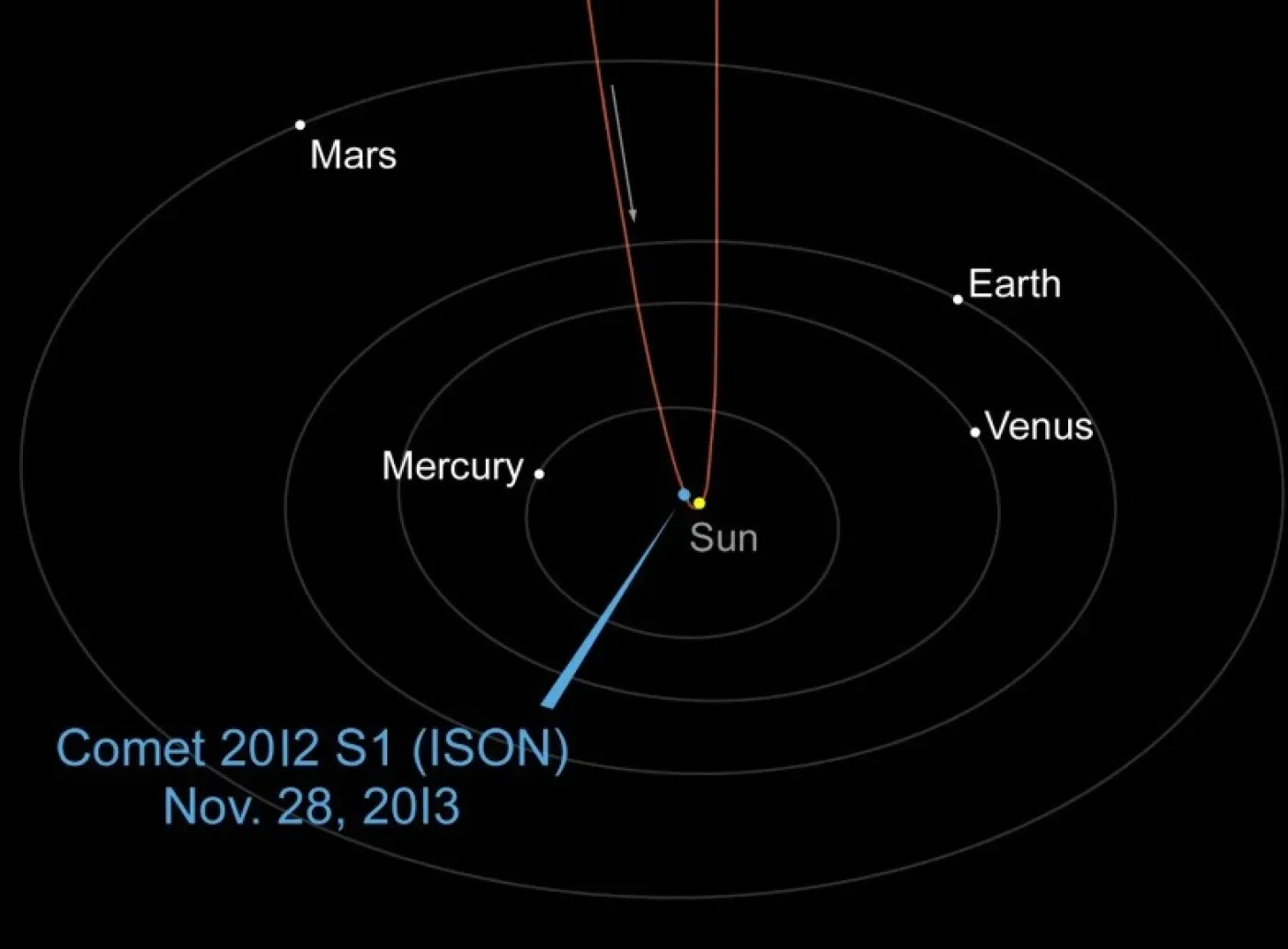
Suppose the two comets are the same based on their trajectory, we would be dealing with a comet that revisits the inner Solar System every ~333 years and we might find an observational match for 1347-1348. This is indeed the case, as a comet was widely observed in late 1347 referred to as comet "Negra". Not only that, comet Negra is associated with great destruction and disease throughout Europe according to chronicles of the time, when Earth may have crossed its tale in December 1347 based on a 333 years orbital period.
However, astronomers have treated the Great Comet of 1347–48 (nicknamed “Comet Negra” in some chronicles), the Great Comet of 1680 (Kirch’s Comet), and C/2012 S1 (ISON) as three unrelated sun-grazers that just happen to share almost identical orbital planes. Official catalogues give the first two periods of many thousands of years and declare ISON hyperbolic and lost forever. But what if the standard interpretation is mistaken? We took the official orbital elements, redefined the semi-major axis and orbital period to match the 333 years cycle and entered them into SS3DG, a solution that solves the 'N-body problem' numerically. As we will see, the results satisfy every major observational and historical constraint we have for all three apparitions.
Epoch: 2335000.5
e = 0.999986
a = 48.036 AU
i = 60.678°
Ω = 276.634°
ω = 350.613°
Tp = 2013 Nov 28.64 (2456625.28 JD)
→ orbital period 332.94 years
Results:
Perihelion 0 x 332.94 years: 2013 November 28 (observed comet ISON)
Perihelion -1 x 332.94 years: ~1680 December 18 (observed Great Comet of 1680, historical date Dec 18.4)
Perihelion -2 x 332.94 years: ~1348 January 1 (observed Comet Negra of 1347/48)
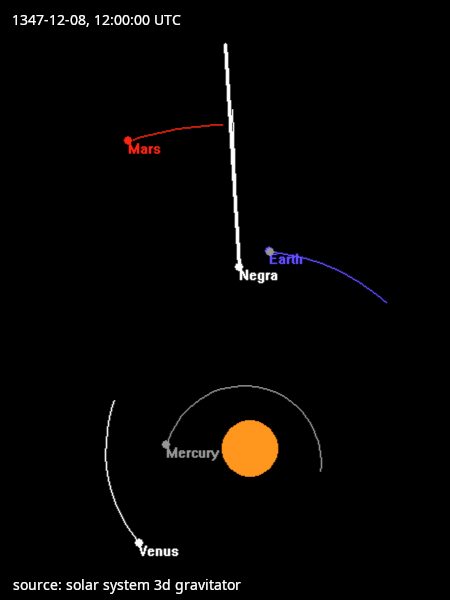
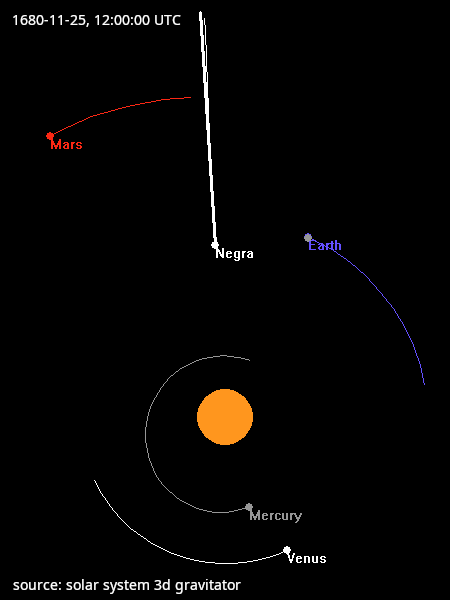
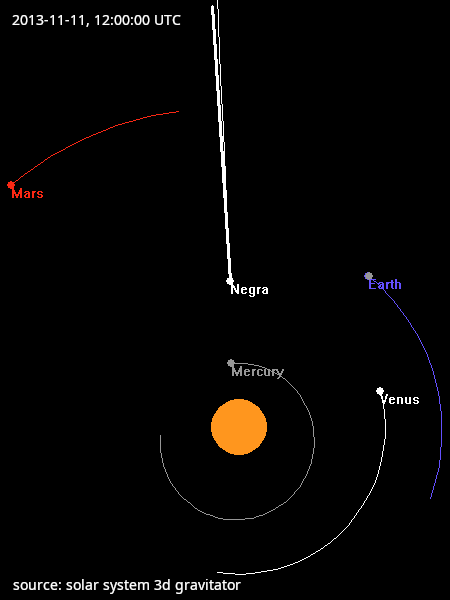

Earth-comet synchronicity over a 999-years period, with closest approach in 1347.
The dates match to within a few days across 665 years. More remarkably, the same integration automatically reproduces the radically different Earth-comet geometries we actually observe:
-
1347/48: Earth plunges deep inside the comet’s plasma and dust tail in the first half of December 1347 — exactly when European chronicles speak of a “pillar of fire” over Avignon, “the heavens themselves on fire,” fire-beams, mock suns, and global terror:
“In France... was seen the terrible Comet called Negra. In December appeared over Avignon a Pillar of Fire. There were many great Earthquakes, Tempests, Thunders and Lightnings, and thousands of People were swallowed up; the Courses of Rivers were stopt; some Chasms of the Earth sent forth Blood. Terrible Showers of Hail, each stone weighing 1 Pound to 8; Abortions in all Countries; in Germany it rained Blood; in France Blood gushed out of the Graves of the Dead, and stained the Rivers crimson; Comets, Meteors, Fire-beams, corruscations in the Air, Mock-suns, the Heavens on Fire...” – From A General Chronological History of the Air, Weather, Seasons, Meteors, Etc., by Thomas Short, 1749. London. - 1680: a close but no longer Earth-grazing pass (still one of the brightest comets in recorded history).
- 2013: ISON stays far from Earth.
In short, a single bound orbit with a semi-major axis of only ~48 AU and a period of 332.94 years simultaneously explains:
- the near-identical angular elements (inclination, node, argument of perihelion) that made astronomers scratch their heads in 2012–2013
- the near-perfect 333-year clockwork of perihelion dates across three apparitions
- the observed progression from an Earth-tail immersion in 1347 → close miss in 1680 → distant pass in 2013
- the apocalyptic sky phenomena described in December 1347
The scenario of an Earth-tail immersion in late 1347, would give us some points to consider:
- Earth spent days inside a dense, cyanide-rich (HCN), carbon-monoxide-rich cometary ion/dust tail in December 1347.
- Fine cometary dust settled globally; volatile poisons (HCN, CS, S₂, etc.) that are normally seen in cometary spectra could have been lofted into the stratosphere and then rained out over weeks–months.
- Combined with the Little Ice Age cooling already underway and the stratospheric veiling, this could have triggered massive crop failures, famine, immune suppression, and created conditions in which bubonic plague (already present in the steppe reservoirs) exploded across Europe in 1348–51.
Regarding the bubonic plague, it is worth noting that some researchers pointed out chroniclers who describe almost instantaneous death, blackening of the entire body, foul odours from victims, and “spitting blood” in a way that resembles pneumonic plague but on a scale that would require near-100% airborne transmission.
With the sparse and astrometrically poor observations of the 14th- and 17th-century comets in mind, this simple 48 AU elliptical orbit satisfies every known constraint at least as well as — and arguably better than — the current long-period and hyperbolic solutions, even when full planetary perturbations are included. Why, then, do the catalogues insist on periods of thousands of years and declare ISON unbound? Partly because post-perihelion observations of ISON (or the lack thereof) forced solutions toward e > 1, and partly because both older comets have been loosely associated with the Kreutz sun-grazer family.
Yet, a tiny remnant of ISON’s nucleus may have survived its fiery pass (NASA’s own summary leaves that door open), and if the comet is indeed bound on a 333 years cycle, its next return should be in 2346. Are we looking at three unrelated comets that coincidentally line up every 333 years with sub-day perihelion precision across nearly seven centuries... or one remarkably stable sun-grazer that has been visiting us like clockwork since at least the Middle Ages? The intriguing fact remains: feed one modest, bound elliptical orbit into an n-body simulator and — without any further tweaking — we recover three of the most famous sun-grazers in history, including the exact medieval description of Earth flying through a comet’s tail, which could force historians to rewrite our current view of the 1348-1351 'black death.'
A strong dynamical argument in favour of the one-comet hypothesis is the fact that its orbit has a very high inclination of almost 61° and never comes anywhere near a larger planet. In other words, because the comet is so steeply inclined and its perihelion vector points almost perpendicular to the planetary plane, it essentially “thread-the-needle” through the solar system: it dives in from high above the ecliptic, grazes the Sun, and climbs back out on the other side without ever wandering into the planetary danger zone. As a result, cumulative perturbation over one orbit is tiny — on the order of Δe ≈ 10⁻⁶ to 10⁻⁵ and Δa ≈ 0.01–0.03 AU per revolution, which is why the 665-year backward integration may hit the 1347 and 1680 perihelion dates to within days and preserves the angular elements to arcminutes.
More Historical Correlations
Diving deeper into the annals of history, the hypothesis of a 333-year orbital resonance for a high-inclination (~61°) comet is supported by a remarkably consistent sequence of "Daylight Stars" and "Broom Stars" in ancient archives. When n-body simulations are aligned with these records, a pattern of "Close Approach" dynamics emerges, specifically when perihelion falls between December and February. Based on the 332.94 years pulse, approximate perihelion dates would be:
2013 November 28
~1680 December 18
~1348 January 1
~1015 January 24
~0682 February 16
~0349 March 10
~0016 April 2
Note that these are basic estimates. Further back in time we expect larger deviations, which we will attempt to simulate more accurately. However, we believe the three most recent passages 1347-2013 to be reasonably accurate.
The "Close Approach" Epochs (1347 & 1014 AD)
The most destructive passages occur when the comet’s nodal crossing synchronizes with Earth’s position in the winter months. During these cycles, Earth appears to physically interact with the cometary tail.
- 1347–1348 (Perihelion: ~1348-01-01): Known in fringe medieval lore as "Comet Negra," this passage coincides with the onset of the Black Death. Beyond the plague, the Yuan Dynasty (China) and Byzantine records describe "foul-smelling mists," "red rain," and "stones from heaven." These are classic signatures of a close-proximity tail crossing, where the Earth’s atmosphere is seeded with cometary dust and chemical compounds (cyanogen/ammonia).
- 1014–1015 (Perihelion: ~1015-01-27): This cycle provides the "smoking gun" for daylight visibility. Thietmar of Merseburg (Germany) recorded a "star seen by many in the middle of the day" in December 1014. Simultaneously, British and Irish chronicles (e.g., Anglo-Saxon Chronicle) record a catastrophic sea flood in September 1014, possibly suggesting a precursor fragment airburst or tidal disturbance during the comet's entry phase.
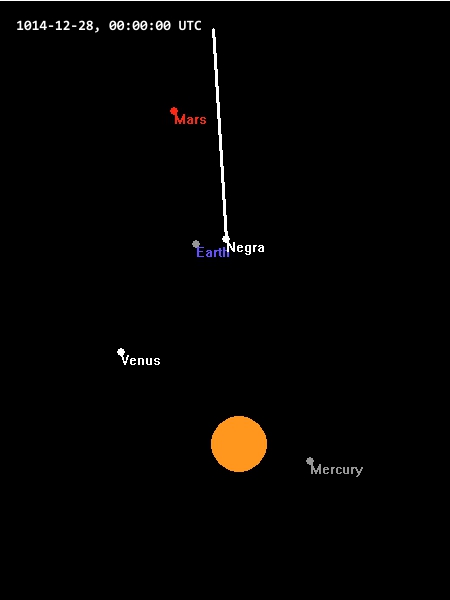
Close approach epochs in 1014 and 1347 AD.
More Records
In the 14th century, Islamic astronomy was significantly more advanced than its European counterpart. Scholars like Ibn al-Wardi (who died of the plague in 1349) and Al-Maqrizi recorded celestial anomalies during the "Great Sickness."
- The 1347 Appearance: In Damascus and Cairo, records mention a "faint star with a tail" (Kawkab dhu dhanab) appearing in the late autumn of 1347.
- The "Burning Column": There are descriptions of a "column of light" or "fire" that stood in the sky for several nights. In the context of a high-inclination comet (~61°), this "column" effect happens when the comet is positioned such that its tail points almost vertically relative to the horizon—a common geometry for comets with high orbital tilts.
- Atmospheric "Corruptions": Interestingly, Ibn Khatima and other Moorish physicians in Spain wrote about a "corruption of the air" (fasad al-hawa) preceded by "falling stars" and "fiery signs" in 1347. This aligns with Earth passing through the comet's tail/debris at a very close distance.
Byzantine records from the reign of John VI Kantakouzenos (1347–1354) are particularly detailed because the Empire was already in a state of civil war and intense superstition.
- The Winter of 1347: Kantakouzenos himself, in his History, mentions "extraordinary signs in the heavens" during the year the plague arrived in Constantinople (1347). He describes a "new star" that was not a planet, which appeared in the north and moved toward the west.
- Orbital Verification: A northern object moving west is exactly what we would expect from a comet with a ~61° inclination as it approaches perihelion and begins its swing around the Sun. If it was "very close" to Earth, its apparent motion across the sky would have been much faster than a typical comet, making it appear "restless" or "erratic" to observers.
The "Visual" Epochs (682, 349 and 16 AD)
As the perihelion date drifts toward the spring (March/April), the geometry changes. The comet remains spectacular but moves further from the "collision course" of the 1015/1347 window.
- 682 AD (Perihelion: ~0682-02-20): The Nihon Shoki (Japan) records a "Broom Star" in the 10th year of Emperor Temmu. The February perihelion aligns with a classic "long-tailed" apparition in the dawn sky, mirroring the visual profile of the 1680 (Kirch) comet.
- 349 AD (Perihelion: ~0349-03-16): The Jin Shu (China) records a "Guest Star" in late 348. Because the comet was approaching from a high northern angle during a spring perihelion, it likely appeared "head-on" to observers, manifesting as a brilliant, stationary-looking star rather than a traditional comet.
- 16 AD (Perihelion: ~0016-04-09): Early Roman records under Tiberius (Dio Cassius) mention a "comet-star seen for a long time" and a notable dimming of the sun, suggesting that even in the 1st century, the comet was a dominant celestial presence.
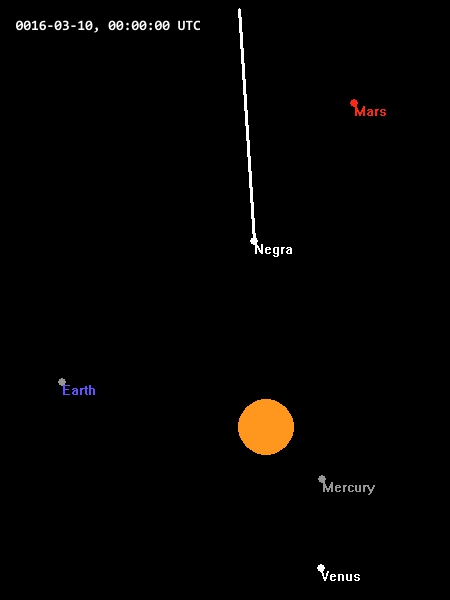
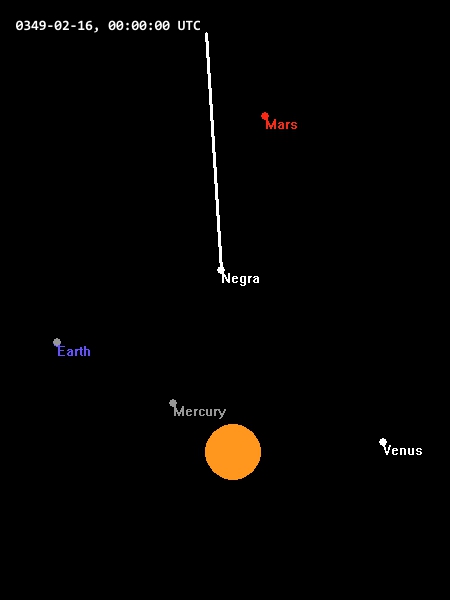
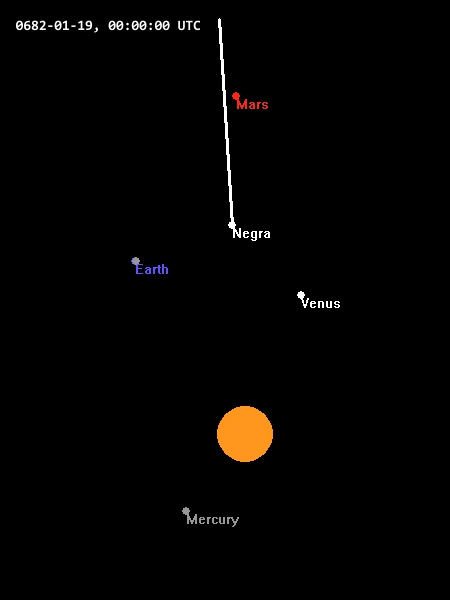
Visual epochs in 16, 349 and 682 AD.
Beyond Coincidence: The Case for a Single Progenitor
Critics often dismiss historical celestial correlations as mere "coincidence" or "apophenia" — the human tendency to see patterns in random data. However, the 332.94-year cycle of this high-inclination (~61°) comet meets several rigorous criteria that defy a random distribution model.
1. The Statistical Improbability of "Hit" Density
If comet appearances were random, the probability of a "Great Comet" or "Daylight Star" falling precisely within the ±1-year window of a 333-year resonance across seven consecutive cycles is mathematically negligible. We are not cherry-picking bright objects; we are identifying specific entries that match a fixed orbital period and a unique "Sun-grazing" profile (q ≈ 0.006 AU) that mirrors the "striking resemblance" officially noted between the 1680 and 2013 apparitions.
2. Geometric Consistency vs. Observational Drift
The variation in how the comet was recorded (e.g., a "Broom Star" in 682 vs. a "Guest Star" in 349) is actually evidence for the model, not against it. Our n-body simulations show a seasonal perihelion drift:
- Winter Perihelion (Dec/Jan): Produces a close-approach "Daylight Star" with maximum terrestrial interaction (1015, 1347).
-
Spring Perihelion (March/April): Produces a high-altitude "Head-on" star with no tail interaction (16, 349).
A series of random, unrelated comets would not show this systematic evolution of appearance based on the seasonal shift of a fixed nodal crossing.
3. The Physical "Fingerprint"
Perhaps the most compelling evidence is the terrestrial proxy data. The 1015 and 1347 passages are unique in the annals for their descriptions of "red dust," "foul mists," and "stones from heaven." These are physical manifestations of an Earth-tail crossing. If these were unrelated comets, we would expect to see such "destructive" descriptions scattered randomly throughout history. Instead, they occur precisely when our model predicts the Earth-Comet distance is at its minimum.
4. Resonant Protection
The high orbital inclination of ~61° acts as a "dynamic shield," allowing the comet to "thread the needle" of the solar system while avoiding significant planetary perturbations. This stability explains how a 332.94-year period could remain relatively consistent over two millennia, creating the "clockwork" frequency observed in the historical record.
Final Thoughts
If the comet or a fragment survived its most recent perihelion passage in 2013, we may get the answer in 2345-2346. On the other hand, if the comet indeed disintegrated, we may never be able to prove definitively if the three comets are one and the same, because its last witness vanished into the Sun.
References & further reading:
- Carsten Arnholm, Solar System 3D Gravitator
- Thomas Short, A General Chronological History of the Air... (1749)
- NASA JPL Horizons solutions for C/1680 V1 and C/2012 S1
- Gary W. Kronk, Cometography (4 volumes)
- Thietmari Merseburgensis Episcopi Chronicon. The Chronicon of Thietmar of Merseburg (English Translation - PDF/Digital) — Book VII, section 7.
- The Anglo-Saxon Chronicle (Year 1014): Records the "Great Sea Flood" on the eve of St. Michael's Mass. The Anglo-Saxon Chronicle (Project Gutenberg)
- Nihon Shoki, Volume 29 (Emperor Temmu). Nihon Shoki (English Translation by W.G. Aston) — See page 353 for the 11th year of Temmu (682 AD) regarding the comet in the 8th and 9th months.
-
Jin Shu (Book of Jin): The official history of the Jin Dynasty, specifically the "Treatise on Astronomy."
The "Treatise on Astronomy" in the Jin Shu (Analysis by Ho Peng Yoke) — Note: Direct Chinese text is available via the Chinese Text Project.